
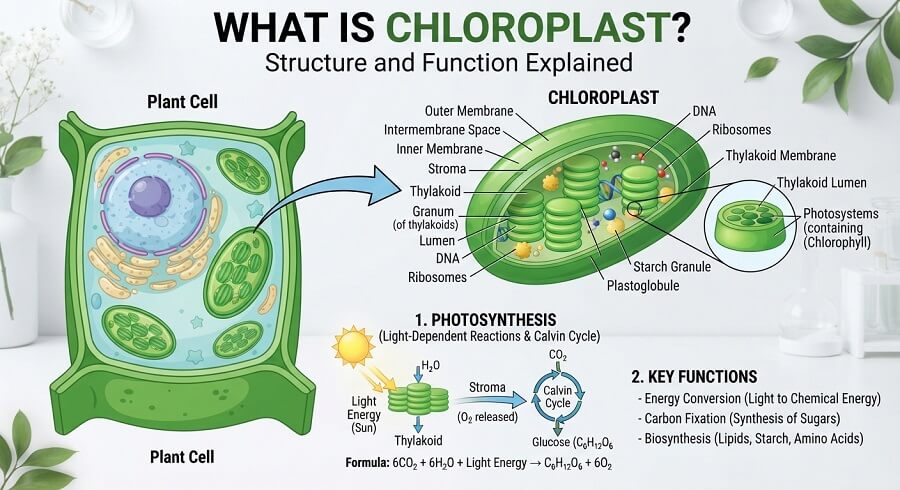
A chloroplast is a specialized organelle inside plant cells and green algae that produces food through photosynthesis. It acts as a miniature solar refinery for the cell. By capturing light energy, it converts water and carbon dioxide into simple sugars. You will find these double-membraned structures inside almost all green plant tissues.
Quick Overview
- Best for: Science students learning plant biology and cell structure.
- Top pick: Plant Chloroplast (Plastid Family)
- Verdict: Chloroplasts are vital organelles that transform sunlight into usable chemical energy.
Basic Definition and Purpose
In simple terms, a chloroplast is an organelle that makes energy for green plants. Plant cells and algae rely on this structure to make their own food. Animal cells do not contain these energy producers.
Chloroplasts belong to a specialized group of plant cell structures called plastids. They usually measure between 4 to 6 micrometers in total diameter. Their thickness typically spans between 1 to 3 micrometers across the cell matrix.
The primary function of this organelle is running photosynthesis. It captures solar photons to power plant growth. Based on the research, this biological mechanism produces vital sugars like G3P and glucose.
Internal Structural Anatomy
A chloroplast features a complex internal layout split into distinct compartments. A double membrane envelope surrounds the entire outer structure of the organelle. This envelope contains an outer membrane, an inner membrane, and an intermembrane space.
Inside the inner membrane sits an aqueous fluid called the stroma. The stroma forms the central liquid matrix of the organelle. It contains crucial enzymes, circular DNA, ribosomes, starch granules, and lipid droplets called plastoglobuli.
Floating within the stroma fluid is an isolated third membrane network. This internal system consists of flat, disc-like membranous sacs known as thylakoids. The interior fluid pocket within a thylakoid sac is called the thylakoid lumen.
Thylakoid discs assemble into tight vertical piles called grana. Structural bridges called stroma lamellae link these separate grana stacks together. Green chlorophyll pigments sit directly inside the thylakoid membranes to harvest light energy.
Photosynthesis and Energy Production
Photosynthesis takes place in two sequential stages inside the chloroplast compartments. The light-dependent reactions happen directly inside the thylakoid membrane system. Protein complexes named Photosystem I and Photosystem II absorb solar photons to split water molecules.
Splitting water molecules pumps hydrogen ions into the inner thylakoid lumen. This mechanism creates an acidic environment with a low internal pH of 4.0. An enzyme called ATP Synthase uses this proton flow to produce chemical energy.
The second stage is the light-independent Calvin cycle inside the stroma. An abundant carbon-fixing enzyme named RuBisCO captures carbon dioxide gas. The stroma enzymes then transform this carbon into three-carbon G3P sugar molecules.
Evolutionary Origin and Genetics
Chloroplasts hold their own separate circular genetic material called cpDNA. They replicate semiautonomously within the surrounding plant cell environment. This unique genetic setup comes from an ancient biological process called endosymbiosis.
Millions of years ago, an early eukaryotic cell engulfed a photosynthetic cyanobacterium. Instead of digesting the microbe, the host cell kept it alive. Over time, this engulfed cyanobacterial ancestor evolved into the modern chloroplast.
Most bacterial genes migrated into the host cell nucleus over evolutionary history. This genetic movement is known as endosymbiotic gene transfer. Today, the host cell nucleus encodes roughly 95 percent of all chloroplast proteins.
Based on the research, interesting evolutionary edge cases exist in nature. The amoeba Paulinella chromatophore evolved a photosynthetic structure completely independently. In contrast, non-photosynthetic algae like Polytomella lost their plastid genome entirely.
Chloroplast vs Other Organelles
Plant cells contain several types of organelles that handle cellular metabolism. You can compare a chloroplast to a mitochondrion, which breaks down cellular nutrients. Mitochondria use their inner membrane folds, while chloroplasts use a separate third thylakoid membrane.
Chloroplasts also differ from other members of the plant plastid family. Chromoplasts lack chlorophyll and display bright carotenoid pigments in flowers or fruits. Leucoplasts are non-pigmented organelles that store starch granules, lipids, or proteins.
Primary plastids possess two membranes from direct cyanobacterial ancestry. Secondary and tertiary plastids contain three or four surrounding membranes. These extra outer membranes resulted from ancient eukaryotic algae being engulfed again.
| Organelle | Pigments & Structure | Primary Biological Role |
|---|---|---|
| Chloroplast | Contains green chlorophyll; three membrane layers | Executes photosynthesis and sugar production |
| Mitochondrion | No chlorophyll pigments; folded inner cristae | Performs cellular respiration and ATP release |
| Chromoplast | Contains red, orange, or yellow carotenoids | Attracts pollinators and colors fruit tissues |
| Leucoplast | Colorless structure without light-absorbing pigments | Stores cellular starches, fats, and proteins |
Functions Beyond Making Food
Chloroplasts do much more than synthesize simple sugars through photosynthesis. They act as essential chemical refineries inside the plant cell. They construct almost all of the plant’s essential fatty acids and amino acids.
These busy organelles also build nucleic acid bases necessary for DNA and RNA synthesis. They produce key defensive chemical signals like jasmonate during pest attacks. Additionally, chloroplast activity regulates guard cells to control stomata openings for water management.
Plant innate immunity relies heavily on chloroplast actions during pathogen infections. When pathogens attack, chloroplasts purposely disrupt their own photosynthetic machinery. They leak toxic reactive oxygen species to trigger deliberate cell death and quarantine pathogens.
Chloroplasts send structural stress signals back to the nucleus using retrograde signaling. This chemical communication alters nuclear gene expression to help plants handle harsh conditions. Scientists also design transplastomic crops by inserting modified genes straight into maternal cpDNA.
Key Takeaways:
- Chloroplasts make sugars using thylakoid light reactions and stroma dark reactions.
- They evolved from an engulfed cyanobacterium through ancient endosymbiosis.
- They synthesize critical plant fatty acids, amino acids, and immune signaling molecules.
- Maternal cpDNA engineering prevents modified genes from spreading through airborne pollen.
Unique Types and Variations
Not all chloroplast structures look bright green in natural environments. Deep-water brown kelp and red plant leaves hide their chlorophyll under accessory pigments. Pigments like phycoerythrin absorb faint underwater light and mask the green color underneath.
Plastid growth varies based on tissue development and environmental signals. Undifferentiated precursor organelles named proplastids sit inside young stem tissue. Dark-grown plant seedlings form etioplasts, which feature a geometric prolamellar body until light appears.
Plastids transform between different active forms as plant tissues mature. Green chloroplasts shift into bright chromoplast structures when fruit ripens on branches. Underground root tissues create specialized leucoplasts called amyloplasts to store heavy starch reserves.
In our experience reviewing plant physiology references like Encyclopedia Britannica, these organelle transformations prove how adaptable plant cells are to environmental changes.
Frequently Asked Questions
What is a chloroplast kid definition?
A chloroplast is a small green engine inside a plant cell that turns sunlight, water, and air into sugar food for the plant.
What is chloroplast vs chlorophyll?
A chloroplast is the whole physical organelle inside a plant cell, while chlorophyll is the green pigment molecule stored inside that absorbs solar light energy.
Do humans have chloroplasts?
No, human cells do not have chloroplast organelles. Humans cannot produce their own food from sunlight and must eat nutrients from plants or other animals to survive.
Where is chlorophyll?
Chlorophyll pigment molecules sit embedded directly inside the thylakoid membranes within the chloroplast organelle of a green plant cell.